Friday, 27 February 2015

Telugu wedding: Pre-wedding customs

The rich and varied cultural heritage of Andhra Pradesh, India, is reflected in the ceremonies conducted there. Almost all festivals are celebrated with religious observances, holding supreme importance in the lives of the residents of the state.
Niśchitārtham (నిశ్చితార్థం)
Niśchitārtham means engagement. The two families meet to perform rituals to make the engagement official. A muhūrtaṃ (auspicious date & time) for the wedding is decided based on horoscopes. The Telugu people generally avoid the months or a time period where Aashaadham, Bhadrapadam and Shunya maasam occurs, because they are considered inauspicious for the ceremonies. The couple is then blessed by elders of both families, and is given gifts including jewelry and clothing by their new family. During this ceremony the future mother-in-law of the bride presents her with clothes, gold and also silverware, formally ending the engagement (Niśchitārtham).
Snātakaṃ (స్నాతకం)
Snātakaṃ means Graduation or Bath Graduate or Post graduation. It is usually performed before house-holder responsibilities are handed over to the Groom. Snaatakam ritual takes place at the bridegroom’s residence before the muhūrtaṃ. As a part of this custom, the groom is asked to wear a silver thread on his body. The ritual is conducted a few hours prior to the wedding.
Kāśī Yātra (కాశీ యాత్ర)
Traditionally, after Snātakaṃ, groom will be eligible for higher studies and he will be eligible to go to Kashi and study further or become Sanyasi. However, as a pre-wedding ceremony, the groom just pretends to go to Kashi and says that he has discarded the worldly pleasures (such as marriage, relations and properties) and is no more interested in leading a family life. He will then be stopped by the brother(cousins) of the bride, who persuade him to assume the responsibility of a house hold as in they tease each other quite a lot and groom readily agrees for it in the end.

Friday, 20 February 2015

Telugu wedding ceremony

The Telugu wedding ceremony is the traditional wedding ceremony of the Telugu people in India. In the 19th century, the ceremony could last up to 16 days (Padahaaru Rojula Panduga). In modern times, it can last 5 or more days, depending on the family's financial and social status.
Vivaham or Wedding considered the strongest of social bonds, is said to spiritually merge two souls opening the doors to "Gruhastaashramam" (household life). As per a Telugu saying, "marriage is supposed to be a family union and not an individual formality".
Telugu marriage is sanctified by seven pledges made by the bride and groom and commences when the bride and groom have completed seven revolutions around a sacred fire. Symbolic gestures and rituals encompass the ceremony and ensure that the bride and groom are united in the presence of Panchabhutaalu (Five essential elements for life) namely Bhumi (Earth), Akaasham (Sky), Agni (Fire), Neeru (Water) and Vaayuvu (air). The ceremony is held under the Kaḷyāṇa Maṇḍapaṃ or wedding pavilion decorated with fresh flowers. "Nādasvaram" (also called Shehnai in North India) an Indian musical instrument traditionally accompanies most Telugu weddings.
Earlier Groom rides an elephant to Bride's place where wedding is supposed to take place. This process is called "Gajaarohana". Nowadays this tradition is fading out.
Some marriages are done in the temple in presence of god but most of them are conducted outside because of the number of people in attendance. After every ceremony they serve food to all the guests which is also the main part of the culture of offering food to anyone who comes on an auspicious day . All the rituals conducted throughout the Telugu wedding ceremony hold religious significance. Each element in the ceremonies is connected with the other and is given special importance.
The decorations mostly consist of flowers and mango leaves in rich colors. The families renovate their houses and invite all the guests going to each of their houses with the kumkuma. It is also a tradition to eat ice cream or sweets before dinner because it is considered auspicious.

Thursday, 12 February 2015

Love


Love is a variety of different feelings, states, and attitudes that ranges from interpersonal affection ("I love my mother") to pleasure ("I loved that meal"). It can refer to an emotion of a strong attraction and personal attachment. It can also be a virtue representing human kindness, compassion, and affection—"the unselfish loyal and benevolent concern for the good of another". It may also describe compassionate and affectionate actions towards other humans, one's self or animals.


Ancient Greeks identified four forms of love: kinship or familiarity (in Greek, storge), friendship (philia), sexual and/or romantic desire (eros), and self-emptying or divine love (agape). Modern authors have distinguished further varieties of romantic love. Non-Western traditions have also distinguished variants or symbioses of these states. This diversity of uses and meanings combined with the complexity of the feelings involved makes love unusually difficult to consistently define, compared to other emotional states.


Love in its various forms acts as a major facilitator of interpersonal relationships and, owing to its central psychological importance, is one of the most common themes in the creative arts.


Tuesday, 10 February 2015

Valentine's Day


Saint Valentine's Day, also known as Valentine's Day or the Feast of Saint Valentine, is a holiday observed on February 14 each year. It is celebrated in many countries around the world, although it is not a holiday in most of them.

St. Valentine's Day began as a liturgical celebration one or more early Christian saints named Valentinus. Several martyrdom stories were invented for the various Valentines that belonged to February 14, and added to later martyrologies. A popular hagiographical account of Saint Valentine of Rome states that he was imprisoned for performing weddings for soldiers who were forbidden to marry and for ministering to Christians, who were persecuted under the Roman Empire. According to legend, during his imprisonment, he healed the daughter of his jailer, Asterius. An embellishment to this story states that before his execution he wrote her a letter signed "Your Valentine" as a farewell. Today, Saint Valentine's Day is an official feast day in the Anglican Communion, as well as in the Lutheran Church. The Eastern Orthodox Church also celebrates Saint Valentine's Day, albeit on July 6 and July 30, the former date in honor of the Roman presbyter Saint Valentine, and the latter date in honor of Hieromartyr Valentine, the Bishop of Interamna (modern Terni). In Brazil, the Dia de São Valentim is recognized on June 12.

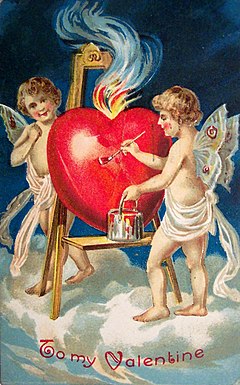
The day was first associated with romantic love in the circle of Geoffrey Chaucer in the High Middle Ages, when the tradition of courtly love flourished. In 18th-century England, it evolved into an occasion in which lovers expressed their love for each other by presenting flowers, offering confectionery, and sending greeting cards (known as "valentines"). In Europe, Saint Valentine's Keys are given to lovers "as a romantic symbol and an invitation to unlock the giver’s heart", as well as to children, in order to ward off Saint Valentine's Malady.[6] Valentine's Day symbols that are used today include the heart-shaped outline, doves, and the figure of the winged Cupid. Since the 19th century, handwritten valentines have given way to mass-produced greeting cards.


Thursday, 5 February 2015

Visiting card


A visiting card, also known as a calling card, is a small paper card with one's name printed on it, and often bearing an artistic design. In 18th century Europe, the footmen of aristocrats and royalty would deliver these first European visiting cards to the servants of their prospective hosts solemnly introducing the arrival of their owners.


Tuesday, 3 February 2015

Wedding invitation


A wedding invitation is a letter asking the recipient to attend a wedding. It is typically written in formal, third-person language and mailed five to eight weeks before the wedding date.

Like any other invitation, it is the privilege and duty of the host—historically, for younger brides in Western culture, the mother of the bride, on behalf of the bride's family—to issue invitations, either by sending them herself or causing them to be sent, either by enlisting the help of relatives, friends, or her social secretary to select the guest list and address envelopes, or by hiring a service. With computer technology, some are able to print directly on envelopes from a guest list using a mail merge with word processing and spreadsheet software.